
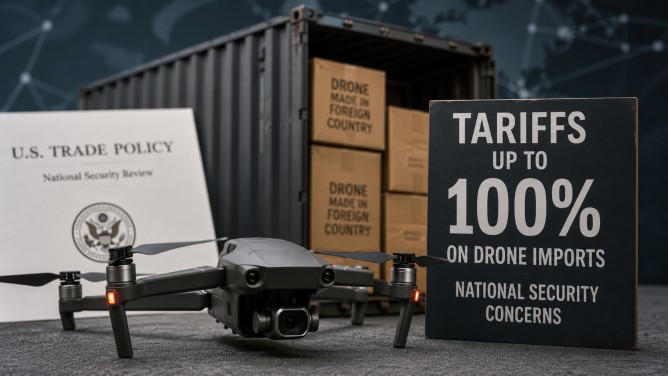
The United States has introduced new tariffs targeting imports of specific drones and their components, aiming to address national security issues and decrease reliance on China-dominated foreign supply chains. The policy enacts a 100% tariff on unmanned aircraft systems, particularly focusing on larger drones exceeding 25 kilograms and those equipped with features pertinent to national security, like thermal imaging cameras and docking stations. Smaller drones are set to incur a 25% tariff.
Additionally, the US will levy tariffs on drone imports and components from a selection of key trading partners. These include the European Union, Japan, Liechtenstein, South Korea, Switzerland, and Taiwan, with a 15% tariff applied. Imports from the United Kingdom will face a 10% tariff, contingent on the hardware, software, and technology being sourced from these nations or the US. The majority of these tariffs are set to be implemented starting September 3.
The White House has emphasized that these measures aim to bolster the US defense and industrial base, encourage the development of domestic drone manufacturing, and generate employment opportunities within the country, all while decreasing dependency on foreign suppliers. This move comes in response to China’s stronghold over the global drone market, with DJI, a company based in Shenzhen, holding a substantial portion of the US commercial drone market and facing US restrictions due to security concerns.
Concerns from US officials have been raised about the potential risks posed by foreign-made drones, including threats related to surveillance, the collection of sensitive data, and potential attacks. In line with these concerns, the US Federal Communications Commission has previously advocated for increased domestic production to mitigate such risks. This decision to impose tariffs unfolds amidst ongoing trade and technology tensions between Washington and Beijing.
The backdrop to these developments includes China’s recent introduction of restrictions that impact drone exports to the US, alongside measures against several American companies. These actions contribute to the broader context of the escalating trade friction and technological rivalry between the two economic superpowers.